The Ultimate Guide to Heavy Equipment Tires in Florida: Selection, Maintenance, and Lifespan
Your heavy equipment is the backbone of every Florida job site. From Miami construction projects to phosphate mines near Tampa, from Orlando developments to agricultural operations in Central Florida, your machines need tires that can take the heat, the sand, and the pounding. Choosing the wrong tire leads to downtime, lost revenue, and safety risks.
This guide will walk you through how to choose heavy equipment tires in Florida, what affects tire life, maintenance best practices, and everything you need to know about off-road tire types.
How to Choose Heavy Equipment Tires in Florida
How to choose heavy equipment tires in Florida starts with understanding your specific application. Not all tires are created equal. A loader tire built for a quarry will perform poorly on sandy soil. An earthmoving tire designed for scrapers won’t work well on a wheeled excavator.
Here are the key factors to consider:
Application Type – Are you loading trucks, grading roads, or excavating foundations? Each task demands a different tread pattern and rubber compound.
Terrain Conditions – Florida’s abrasive sand, limestone, and wet conditions require specialized tread designs. Mud-terrain tires have deep lugs. Sand tires need self-cleaning treads.
Equipment Type – Wheel loaders, excavators, scrapers, and skid steers all use different tire sizes and constructions. Always match the tire to the machine.
Load Capacity – Heavier equipment requires tires with higher ply ratings and reinforced sidewalls. Never underspec your tires for the weight they carry.
Heat Resistance – Florida’s intense summer heat accelerates tread wear. Choose heat-resistant compounds for extended pavement operation.
At Heavy Duty Tires, our experts help you navigate these decisions with nationwide inventory and fast shipping to any Florida location.
What Affects Heavy Equipment Tire Life?
What affects heavy equipment tire life is a critical question for any fleet manager. Tires are a major operating expense. Extending their life saves thousands of dollars annually.
Here are the most common factors that reduce tire lifespan:
Improper Inflation – Under-inflation causes excessive heat buildup and sidewall flexing. Over-inflation leads to center tread wear and reduced traction. Check pressures daily.
Operating Speed – High speeds generate heat that degrades rubber compounds. Most heavy equipment tires are rated for low speeds (25-40 mph). Exceeding those limits kills tires fast.
Terrain Abrasiveness – Florida’s sandy soil and limestone are naturally abrasive. Rock-duty tires with cut-resistant compounds last significantly longer than standard tires.
Load Management – Overloading a tire beyond its rated capacity causes internal damage that may not be visible until failure. Always respect load ratings.
Poor Maintenance – Neglecting rotations, alignments, and inspections leads to uneven wear and premature replacement. A tire maintenance guide helps extend life.
Environmental Exposure – Ozone, UV radiation, and chemical exposure degrade rubber over time. Store spare tires indoors when possible.
Proper selection and maintenance from Heavy Duty Tires maximize your ROI on every tire purchase.
Tire Maintenance Guide for Heavy Equipment Operators
A solid tire maintenance guide protects your investment and prevents catastrophic failures. Follow these best practices:
Daily Inspections – Check for cuts, bulges, embedded objects, and abnormal wear patterns. Remove rocks or debris lodged in treads.
Pressure Checks – Use a calibrated gauge to check inflation pressures every morning before operation. Adjust for temperature changes.
Tread Depth Monitoring – Replace tires when tread depth reaches 25-30% of original. Bald tires lose traction and are more prone to punctures.
Rotation Schedules – Rotate tires between positions every 500-1,000 hours to promote even wear. Front tires on loaders wear differently than rears.
Wheel Alignment – Misaligned axles cause rapid shoulder wear. Have alignment checked annually or after any major impact.
Proper Storage – Store spare tires in a cool, dry place away from sunlight and ozone sources like electric motors.
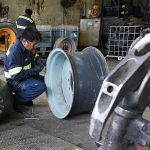
Heavy Duty Tires offers full-service support, including installation, maintenance, and expert consultation for Florida operations.
Tire Lifting Equipment Buying Guide
Handling heavy equipment tires safely requires the right tools. This tire lifting equipment buying guide helps you choose wisely:
Tire Manipulators – Hydraulic attachments for wheel loaders and telehandlers. Ideal for large earthmoving tires up to 63 inches.
Tire Handling Carts – Manual or powered carts for moving tires around shops and warehouses. Look for adjustable width and tilt features.
Service Trucks – Mobile service vehicles equipped with compressors, tools, and tire manipulation arms. Essential for field repairs.
Hoists and Cranes – Overhead hoists or jib cranes for removing tires from large equipment. Ensure capacity exceeds your heaviest tire.
Safety Cages – Inflate tires inside a safety cage to contain potential blowouts during seating and inflation.
When purchasing lifting equipment, prioritize safety features, weight capacity, and compatibility with your tire sizes. Heavy Duty Tires can recommend solutions tailored to your fleet.
Off-Road Tire Types for Heavy Machinery in Florida
Understanding off-road tire types for heavy machinery in Florida helps you match the right tire to your terrain:
Loader Tires (L-2, L-3, L-4, L-5) – Designed for wheel loaders and front-end loaders. L-3 offers smooth tread for hard surfaces. L-4 and L-5 have deeper tread for rock and demolition work.
Earthmoving Tires (E-2, E-3, E-4) – For scrapers, graders, and dozers. E-3 is standard for dirt and gravel. E-4 has extra tread depth for severe rock conditions.
Excavator Tires – For wheeled excavators used in construction and utilities. Look for cut-resistant compounds and reinforced sidewalls.
Skid Steer Tires – High-traction treads for compact loaders. Choose solid tires or foam-filled options for puncture-prone environments.
Rock Duty Tires – Extra-thick sidewalls and deep treads for quarry and demolition work. Resists cuts and punctures from sharp limestone.
Sand and Flotation Tires – Wide footprint and self-cleaning treads for Florida’s sugar sand. Prevents sinking and spinning.
Mud Terrain Tires – Aggressive lugs that clean themselves out. Ideal for North Florida marsh areas and wet conditions.
Heavy Duty Tires stocks all these types with nationwide shipping to Florida job sites.
Construction Tire Selection Guide for Florida Operators
This construction tire selection guide simplifies your decision-making:
| Application | Recommended Tire Type | Key Features |
|---|---|---|
| Sandy soil (Central Florida) | Flotation / Sand tires | Wide footprint, self-cleaning tread |
| Rocky/limestone (Miami-Dade) | Rock duty / L-4 or L-5 | Cut-resistant, reinforced sidewalls |
| Wet/muddy (Panhandle) | Mud terrain | Deep self-cleaning lugs |
| Highway/pavement (urban) | Heat-resistant compounds | Extended wear at higher speeds |
| Demolition/recycling | Foam-filled / Solid | Puncture-proof, zero flats |
| General construction (mixed) | L-3 (loader) / E-3 (earthmoving) | All-around performance |
When in doubt, consult the experts at Heavy Duty Tires. We evaluate your equipment, terrain, and budget to recommend the optimal tire.
Difference in Tire Types: What You Need to Know
Understanding the difference in tire types prevents costly mismatches:
Radial vs. Bias – Radial tires run cooler and offer better fuel economy. Bias tires have stronger sidewalls for severe service. Choose based on your operation.
Pneumatic vs. Foam-Filled – Pneumatic tires provide cushioning but can go flat. Foam-filled tires are puncture-proof but ride harder and cost more.
Smooth vs. Traction Tread – Smooth tread (ribbed) is for hard surfaces like pavement. Traction tread (lugged) is for soft ground and loose materials.
Standard vs. Reinforced – Reinforced tires have higher ply ratings and stronger sidewalls for heavy loads and abusive conditions.
Heat-Resistant vs. Standard Compound – Heat-resistant compounds use specialized rubber that withstands prolonged high-speed operation in Florida’s climate.
Heavy Duty Tires carries all variations and provides expert guidance on the right choice for your specific needs.
Original Equipment Tire Guide for Replacement
An original equipment tire guide helps you match replacement tires to factory specifications. Why does OE matter?
Load Ratings – OE tires are engineered to support the maximum weight of your equipment. Underspecing risks structural failure.
Dimensions – Incorrect sizes cause speedometer errors, clearance issues, and drivetrain damage. Always verify diameter, width, and offset.
Tread Depth – OE depths balance traction and wear life. Deeper treads increase traction but run hotter. Shallower treads last longer on hard surfaces.
Compound – OE compounds match the intended operating environment. A tire designed for Midwest clay won’t perform in Florida sand.
Ply Rating – Higher plies add durability but reduce ride comfort. Follow the equipment manufacturer’s recommendations.
Heavy Duty Tires stocks genuine OE-equivalent tires from leading brands like Alliance, Camso, Firestone, Galaxy, Goodyear, Maxam, and Titan. We help you find the exact match for your machine.
Why Heavy Duty Tires Is Florida’s Trusted Partner
With nationwide inventory and deep expertise, Heavy Duty Tires serves construction, mining, and industrial operators across Florida.
Nationwide Inventory – We stock loader tires, earthmoving tires, excavator tires, skid steer tires, and foam-filled assemblies. If you need it, we have it.
Fast Shipping – Same-day shipping to Miami, Orlando, Tampa, Jacksonville, Fort Myers, Naples, West Palm Beach, and the Florida Panhandle.
Expert Support – Our specialists help you select, maintain, and replace tires. We don’t just sell tires. We partner for your success.
Full-Service Options – Installation, maintenance, inspections, and eco-conscious tire disposal. One call handles everything.
Trusted Brands – Alliance, Camso, Firestone, Galaxy, Goodyear, Maxam, OTR, Primo, Sentry, Traxter, Titan, Turbo, and Xtreme.
Frequently Asked Questions
How often should I replace heavy equipment tires in Florida?
Replace tires when tread depth reaches 25-30% of original, when sidewall damage is visible, or when age exceeds 5-7 years (even if tread looks good). Florida’s heat accelerates rubber aging.
What causes uneven wear on heavy equipment tires?
Uneven wear typically results from improper inflation, misaligned axles, worn suspension components, or mismatched tire sizes. A professional inspection identifies the root cause.
Can I mix tire types on the same axle?
No. Never mix radial and bias tires on the same axle. Also avoid mixing tread depths, sizes, or ply ratings. This causes handling issues and rapid wear.
What is a foam-filled tire? Do I need it?
Foam filling replaces air with a polyurethane compound that never goes flat. Ideal for demolition, scrap handling, recycling, and other high-puncture applications. Heavy Duty Tires offers foam-filled assemblies for most equipment.
How do I store spare heavy equipment tires?
Store indoors, away from sunlight, ozone, and extreme heat. Stack vertically on racks, not horizontally. Keep away from electric motors, welding equipment, and chemical fumes.
Does Heavy Duty Tires offer mobile tire service in Florida?
Yes. We provide installation, repair, and maintenance services at your location. Our service trucks are equipped to handle most heavy equipment tire needs on site.
Ready to Optimize Your Tire Program?
You don’t have to guess when choosing heavy equipment tires. Heavy Duty Tires brings decades of expertise, nationwide inventory, and Florida-specific knowledge to every customer.
Contact us today for a free consultation. Whether you need a single replacement tire or a fleet-wide maintenance program, we are here to help.